The year is 1958, and Ronnie Simison is working on his farm on South Ronaldsay, in the Orkney Isles of Scotland. There is a mound close to the cliff edge, and Ronnie notices some horizontal stones poking out from it. Taking a spade, he digs down, finding a wall. Close to its base, he finds a mace head, three stone axes, a black ‘button’, and a small chert knife.
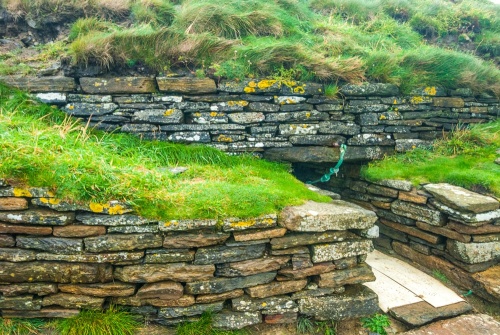
He uncovers a lintel and realises this is some kind of structure. It’s not long before he’s revealed a small entrance leading to a low tunnel. Crawling inside, lit only by his cigarette lighter, Ronnie finds himself staring at around thirty human skulls!
Of course, he closed up the site, reported it to the authorities, and waited for some form of official archaeology to take place. And he waited…
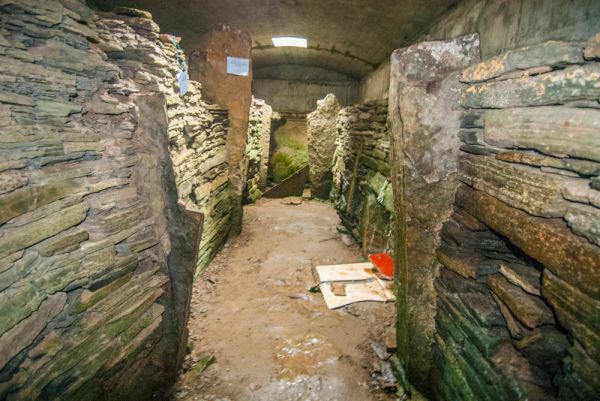
Twenty years later, and with no word of any official interest, Ronnie finally opened up the tomb again himself. What he found within was amazing. Skulls lined the walls and, when the excavation was complete, there were 16,000 bones, the remains of at least 342 individuals. Strangely, in amongst them were the remains of over 14 white-tailed sea eagles.
What was so special about the sea eagle? Was it an animal sacred to the tribe that inhabited the area? Were the birds interred with their chiefs or their shamans?

Outside, the tomb was no less interesting. Around the door were the remains of many sacrificial animals, mainly calves. They appeared to have been brought to the tomb, slaughtered, then dismembered. They had left the meat lying at the door, perhaps as an offering to the dead or the ancestors. Perhaps as a meal for the sea eagles!
Opposite the entrance was a pile of pottery. Large numbers of these earthenware vessels had been brought to the tomb, then deliberately smashed.
It may spoil the effect slightly when we later discover, through radiocarbon dating in 2006, that the eagle bones were not interred with the human occupants. They were buried in the tomb between 500 and 1,000 years later, at the very end of the Neolithic period. Sad as that is, it shows that the tomb had ceremonial importance to people living on the island for over 1,000 years. Think about that in modern-day terms, and you’ll find that 500 years ago was the reign of Henry VIII in Britain. 1,000 years ago was the reign of the last Anglo-Saxon king Harold II, destined to die at the Battle of Hastings in 1066.
It makes you wonder how much more ancient history is waiting to be discovered by one person with a spade…
While you’re here, take a look at this new book promotion. More than 40 books in the First in Epic Series category for you to browse through… and all free!

A Bright Cold Day in April is still running too. Check it out here!

Until next time.
D J Eastwood


 The Apprentice Tattoo