Blog

What (we think) we know about the Neolithic.

Firstly, Neolithic people were Homo Sapiens, just like us. They weren’t some sort of ancient thugs, incapable of rational thought. Given a modern education, there’s no reason to believe they would have fared any worse than you or me. We’d have recognised a lot about their lives, but we would have struggled with the sheer amount of hard work that was required to live a ‘civilized’ life.

Housing.

The style of housing would have varied from place to place. In Orkney, where the sedimentary rock splits easily, houses had stone walls, and some had huge slabs of stone as roofing slates. In other places, wooden frames would have been the norm. Low walls may have been wattle and daub, woven ‘basket’ type walls, coated in mud. Roofs would likely have been some form of thatch, either from naturally occurring reed, or straw from their grain crops.

Floors would have been beaten earth, and the smoke from the central hearth would filtered out through the roofing material, or through a smoke hole. In Orkney, they even built furniture from the abundant stone.

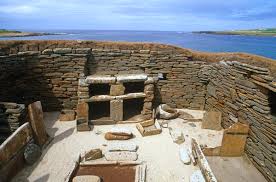
Reconstruction at Stonehenge museum.
Skara Brae, Orkney.

Food.

The Neolithic, or New Stone Age, marked the introduction of agriculture. No longer did the population spend all their time hunting and gathering. They farmed the land, growing crops and domesticating animals.

Their main crop was grain, and archaeological evidence shows that this would have been ancient strains of barley or wheat. Tilling would have been done by hand and, though we don’t know how they processed and stored their grain, it would have been labour intensive. Flour would have been ground between two rocks, and quern stones, ground away by repeated use, have been found at many sites. The resulting flour would have contained a quantity of rock dust, which would have worn your teeth away quickly.
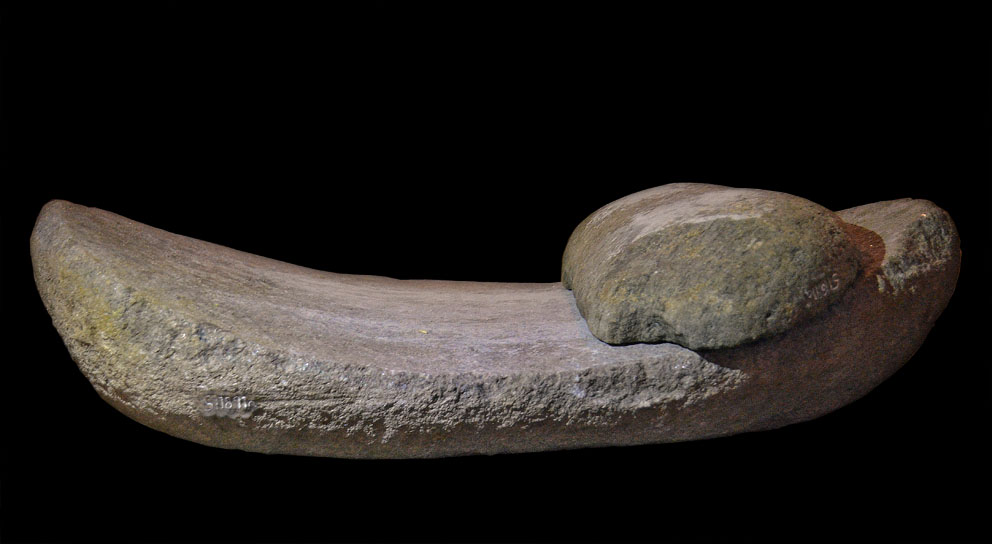
Neolithic Quern stone. Photo by Per Storemyr.

Neolithic people kept cattle and pigs, but evidence from bones found at archaeological sites show that they still hunted wild animals too. Wild boar, deer, and Aurochs, giant wild cattle, also formed part of their diet. There is no evidence that our ancestors kept sheep, nor that they utilised horses for riding or for draught animals.

We don’t know that they grew vegetables, probably relying on foraging to meet their needs. There is some evidence that they grew flax, though whether for its seeds of for fibre to make linen is not known.

So, a day in their lives may have included digging the fields, sowing, reaping, threshing or winnowing grain. They would have ground grain, butchered meat, cooked over an open fire, and eaten from wooden or earthenware bowls.

Well, that’s exhausted me!

Thanks for reading.

D J Eastwood.

A Journey into the Neolithic…

Thank you for visiting my website.

The Apprentice Tattoo is the first novel in a series of historic fantasy stories set in the late Neolithic period. I’ll be blogging about the stories and characters, the settings, and life on the Outer Hebrides.

Sign up to my mailing list to receive the latest blog posts, and news of publication.

This is where it all began.

Callanish stones, on the west side of the Isle of Lewis, Scotland.

Jane and I moved to the Western Isles in October 2005, and within a few days we’d made our first visit to the Callanish stone circle together.

There aren’t a lot of tourists about on the Isle of Lewis, once the summer is over, and we had the hilltop to ourselves for a short while. The stones looked dramatic, stark against a dark sky, threatening rain. We walked the length of the northern avenue, inspected the ring of stones and the central megalith. We walked along the ‘arms’ of the cross, pointing roughly east, south and west… then we retired to the cafe.

Warm and dry, with a latte and a piece of cake, I wondered about the people who built this monument. Who were they? We know so little about a society that could raise huge slabs of stone that have stood for 4500 years. What did they hope to achieve by building Callanish, and so many other sites throughout Britain?

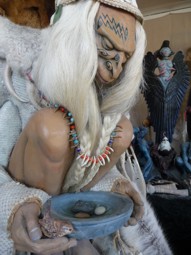
Was the site for religious practice? Was it a calendar or a solar observatory? As I sat, mulling over who the Neolithic people were, I spotted a sculpture, standing against the wall, a man crouched over a scrying bowl, tattoos adorned his face, and a wren perched on his hand.

Who was he? The name of the sculpture was ‘The Messenger’ and that’s just what he was doing, seeing the images in his bowl of water and relaying them to his tribe.

That figure was made by sculptor/painter Simant Bostock from Great Bernera, who has since become a good friend.

The figure became Albyn, Spirit Messenger of the Hill Clan of the Tribe of the West. Guardian of the great stones of Classac, plant master, lore master and healer. Though he is not the main character of my novel, The Apprentice Tattoo, he is a major influence on Col and Talla, and features in his own novella, Talisman of Fire.

So the story began. A man, a place, and a point in history. The protagonists, Col, a sixteen year old orphan, and Talla, a freed slave the same age, soon followed. When the weather changes, and their clan’s crops begin to fail, someone must make a journey to find out the reason for the Spirits’ anger with the tribes of man.

The Apprentice Tattoo is the first in a series of linked novels and novellas available soon.

D J Eastwood